
Briefing Deadlines Fixed

A vintage image of a girl in a boat adorning a calendar from January 1920

The Appellate Rules Committee was not caught without a paddle and fixed a deadline glitch before January 1, 2019.

The Florida Supreme Court fixed briefing deadlines for cross-appeals and dependency and parental rights termination cases, effective January 1, 2019 at 12:03 am.

One of the biggest changes to the Appellate Rules this year is the counterbalancing of the deletion of 5 extra days for mailing with the lengthening of most appellate deadlines. Generally speaking, most deadlines that were formerly 5 days are now 10, for example, and the brief deadlines that used to be 20 days are now 30, and deadlines that used to be 10 days are now 15. You read that right — even though we’ve lost mailing days, we generally now have five or more additional days to serve most items. (Why or more? Because when the Court took away mailing days, it also gave a little extra boon of allowing you to start counting “on the next day that isn’t a “Saturday, Sunday, or Legal Holiday” rather than the next day, so you are no longer starting 3 days into your response time when you walk into your office on Monday morning to find something was filed after hours on Friday. We break down the new math in a prior blog post).

With all of those rule changes (three different orders!) something was bound to fall through the cracks. Under the October 25, 2018 orders, two appellate rules — Rules 9.146 and 9.210 — inadvertently kept the old, shorter deadlines. Luckly, the Appellate Rules Committee was on it, and moved the Florida Supreme Court for rehearing to fix the oversight. Rather than grant rehearing, the Court treated the motion as an “out of cycle report” from the committee, adopting the changes and making them in effect as 12:03am on January 1, 2019. See In re Amendments to Florida Rules of Appellate Procedure 9.146 & 9.210, No. SC18-1917, 43 Fla. L. Weekly S602 (Fla. Dec. 6, 2018)[.pdf]. Now cross appeal briefs have the same amount of time as initial and answer briefs, 30 days from service of the last brief. See Rule 9.210. And in dependency and termination of parental rights proceedings, practitioners also have the benefit of additional time (30 days for an answer and 15 days for a reply). See Rule 9.146.

The fully integrated .pdf rule set is now available on the Florida Bar’s website. Moreover, the fully integrated revised rules are also available at http://rules.floridaappellate.com.
a screen capture from the Florida e-filing portal initiation page with text and a map of the Florida court system

First and Third DCAs Transition to ePortal for Electronic Filing

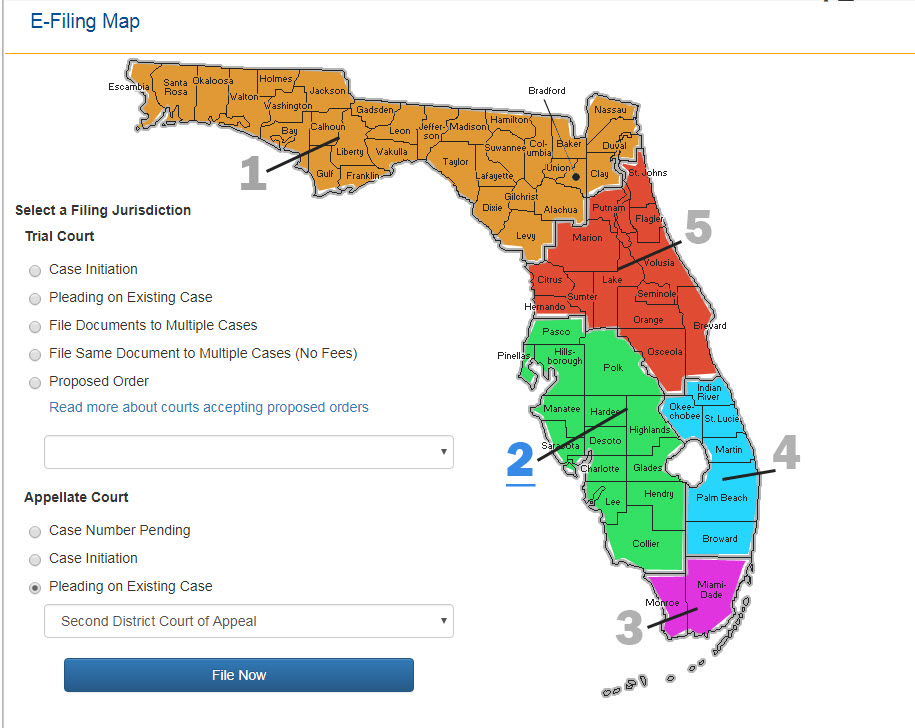
a screen capture from the Florida e-filing portal initiation page with text and a map of the Florida court system

Your new first step to filing in all of the Florida District Courts of Appeal will be this screen.

The First and Third DCA’s yesterday announced that they will follow the other District Courts of Appeal in transitioning away from filing through eDCA and onto electronic filing through the statewide ePortal after hours on February 11, 2019. With this transition, all five District Courts of Appeal will have moved to ePortal filing. Be ready! If you have a deadline on February 11, you should plan to file in eDCA prior to 5 pm, or filing being shut off due to the transition.

New Rule 9.380 Allows Notification of Related Cases

A public domain image of sketches of various courtroom scenes

Are these cases related?
If they are, now you can tell the appellate court.
Source: The Miriam and Ira D. Wallach Division of Art, Prints and Photographs: Print Collection, The New York Public Library. Familiar scenes and faces in court. Retrieved from http://digitalcollections.nypl.org/items/9b51c6ed-b3d7-a26c-e040-e00a18061941


Among the many rule changes effective January 1, 2019, the Florida Supreme Court has created a new mechanism to notify an appellate court of related pending cases. New Rule 9.380 allows parties, without argument, to inform an appellate court of “related case or issue” that is either “arising out of the same proceeding in the lower tribunal,” or, helpfully, “involving a similar issue of law.”

How is this helpful to the appellate practitioner? If you are watching an issue develop and percolate in the trial courts or district courts, you can now notify the courts of other pending appeals or trial court decisions on the issue. Make note that this notice is not an opportunity to make additional argument: the rule expressly states that the notice “shall not contain argument.” Still, it’s a way to direct the courts to attempt uniformity in rulings.

Because there is no argument involved, the notice should follow the simple format of new Rule 9.900(k) [.pdf].