
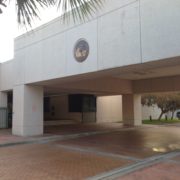
5th District Court of Appeal

Fifth District to Allow Parties to Appear Remotely at Oral Argument

The Fifth District Court of Appeal has put in place a pilot program allowing attorneys and parties to appear at Oral Argument remotely.  The limited program is the first of its kind in Florida.

5th District Court of Appeal Oral Argument

You will be able to avoid a visit to Florida’s 5th District Court of Appeal under the pilot program launching June 5, 2018.

The details of the new program

Starting on June 5, 2018, the Fifth District will allow parties set for Oral Argument to appear either in person at its Daytona Beach courthouse, or remotely from the Marion County Courthouse in Ocala.  The details are set forth in Administrative Order No. AO5D18-01 [.pdf].  In brief,

  • Participation is completely voluntary, and either one or both sides may participate.
  • Any technological problem on the day of argument will result in switching to standard teleconference.
  • Remote oral arguments will be placed first on the daily docket.
  • Courtroom decorum rules apply at the remote location, so no flip flops!

How to sign up

To participate, a party must file a “Notice of Remote Argument,” copied to the opposing party, and send an email to the Fifth District’s clerk.  These must be filed and sent no later than seven days before the scheduled oral argument.  No order will issue – the remote argument is deemed granted upon the Marshal replying with a confirmation email.

Is this the future?

Probably, but it’s not all positive.

There are many benefits to the application of technology to the judiciary–see some of our past articles on e-filing, electronic access, and other technology changes for some examples.  Travel for oral argument is not an insignificant burden on parties and attorneys, both in time and money.  Removing that barrier will allow parties freedom and a more academic determination as to whether to pursue oral argument.

But there is certainly something to be said about appearing before the courts in person.  The parties only have a few precious minutes of face time with the court, and anyone who has used videoconferencing on their own knows that it is possible for something to be lost in translation.  The question will be whether remote appearances can adequately provide the same level of familiarity and experience.  Only time will tell, and the answer will probably not be determined until long after June 5.


Blurred Lines and Appellate Preservation

Gaye Family lead counsel Richard Busch (left) explains the surprising preservation issues.

The higher the stakes in the litigation, the more important it is to have an appellate nerd in your corner, because you can’t make your arguments to the appellate court if you haven’t preserved them at trial. Most folks who follow copyright law are aware that the Ninth Circuit late last month upheld the jury verdict in favor of Marvin Gaye’s family holding that the song Blurred Lines infringed the copyright in Marvin Gaye’s Got to Give it Up. See Williams v. Gaye, 885 F. 3d 1150 (9th Cir. 2018) [.pdf]. And while there are a lot of fascinating copyright issues there, even more important are the appellate preservation issues — the lawyers representing Thicke and Williams tanked large portions of their appeal before they even got there by failing to speak up at two important points at the trial: At the close of plaintiff’s evidence, and before the jury was dismissed after rendering its verdict.

Failure to make a Rule 50(a) Motion

In Federal Court, the rule that covers judgment as a matter of law (also sometimes called judgment notwithstanding the verdict or JNOV from the Latin judgment non obstante veredicto) requires that in a jury trial the Defendant must make a motion at the close of plaintiff’s evidence (Rule 50(a)) and then renew that motion at the end of the case (Rule 50(b)) in order to preserve a challenge to the sufficiency of the evidence. The Defendants were left with arguing that “a colloquy between their counsel and the district court regarding jury instructions and verdict forms qualifies as an “ambiguous or inartfully made” Rule 50(a) motion,” and should suffice for preservation purposes, but but the Court found that colloquy fell “far short” of even an inartful motion, and found sufficiency of the evidence unpreserved. Ouch. Williams v. Gaye, 885 F. 3d 1150, n.21 (9th Cir. 2018). In Florida, the equivalent requirement is for a motion for directed verdict.

Failure to Object to Jury’s Verdict

Defendant’s waived their objection to an alleged inconsistency in the jury’s verdict by failing to object before the jury was discharged. And this was not a controversial point — it was a pretty black letter rule that the court mentioned with citation to two older cases and moved on quickly. That objection must, must be made before the jury is discharged.

It can be very hard in the heat of battle — and trial can be a battle — to remember every possible preservation issue. That’s why we recommend you have an appellate specialist on your trial team. What you don’t want is to blur the lines of preservation.

Thank you to the panelists at the Florida Bar Business Law Section’s 9th Annual Intellectual Property Symposium for their fascinating presentations!

4th District Shortens Allowable Extensions for Reply Briefs and Criminal Appeals

The Fourth District Court of Appeal has shortened the allowable time period for agreed extensions of time: Effective May 1, 2018, parties will only be allowed to agree to 90 days for an initial or answer brief, and 15 days for a reply brief. The Court has also shortened the agreed extension period for criminal appeals significantly, once again applying the same standards to criminal and state appeals.

The new order, AO 2018-1 [.pdf], keeps the amount of time of an agreed extension for the initial brief at 90 days (which in 2016 came down from the original 120 days), but shortens the reply brief stipulation time from 30 days to 15. See AO 2016-1 [.pdf]. When the Fourth District first allowed agreed enlargements in 2011, the time periods were much larger: 120 days for initial or answer, and 60 days for reply. In 2016, the Court changed the rules to keep the 120/60 for criminal, but shorten it to 90/30 for civil. The new Order applies to both civil and criminal cases, and once again aligns the timing for both. Now, however, the time for a reply brief is even shorter, and the rule is 90/15 for all.

Be on the lookout, as we will soon be offering our readers a handy download to keep all of the different rules straight! The download is ready! Click here to sign up for our email newsletter and receive a link to download our guide.